From Activity to Impact: Why Every Nonprofit Needs a Logic Model
Nonprofit leaders are often asked to demonstrate impact. Funders want evidence that investments are making a difference. Boards seek clarity on organizational effectiveness. Staff members want confidence that their efforts are creating meaningful change. Yet many organizations find themselves reporting primarily on activities: how many programs were delivered, how many participants attended, or how many volunteer hours were logged. While these metrics are important, they tell only part of the story.
The question that matters most is: What changed because of those activities? This is where logic models become invaluable.
What Is a Logic Model?
At its core, a logic model is a visual representation of how a program is expected to create change. It illustrates the logical connections between the resources invested, the work performed, and the outcomes achieved. Think of a logic model as a roadmap. It helps organizations articulate not only what they do, but why they believe those activities will lead to desired results.
Far from being a new concept, logic models have been used for decades across sectors—including government agencies, nonprofits, international development organizations, and the private sector—to strengthen planning, performance measurement, and evaluation. Today, they remain one of the most effective tools for aligning strategy, implementation, and impact.
Moving Beyond Counting Activities
Most nonprofits are skilled at tracking operational metrics:
- Funds raised
- Staff and volunteer hours
- Programs delivered
- Participants served
- Educational materials distributed
These measures provide important information about organizational activity and capacity. However, they do not answer the critical question of whether those activities are producing meaningful change.
For example, a youth leadership program may report:
- 20 workshops delivered
- 150 participants served
- 500 hours of programming provided
These outputs tell us what happened. They do not tell us whether participants developed stronger leadership skills, increased confidence, or became more engaged in their communities. A logic model helps organizations connect activities to outcomes and identify the evidence needed to demonstrate success.
The Four Building Blocks of a Logic Model
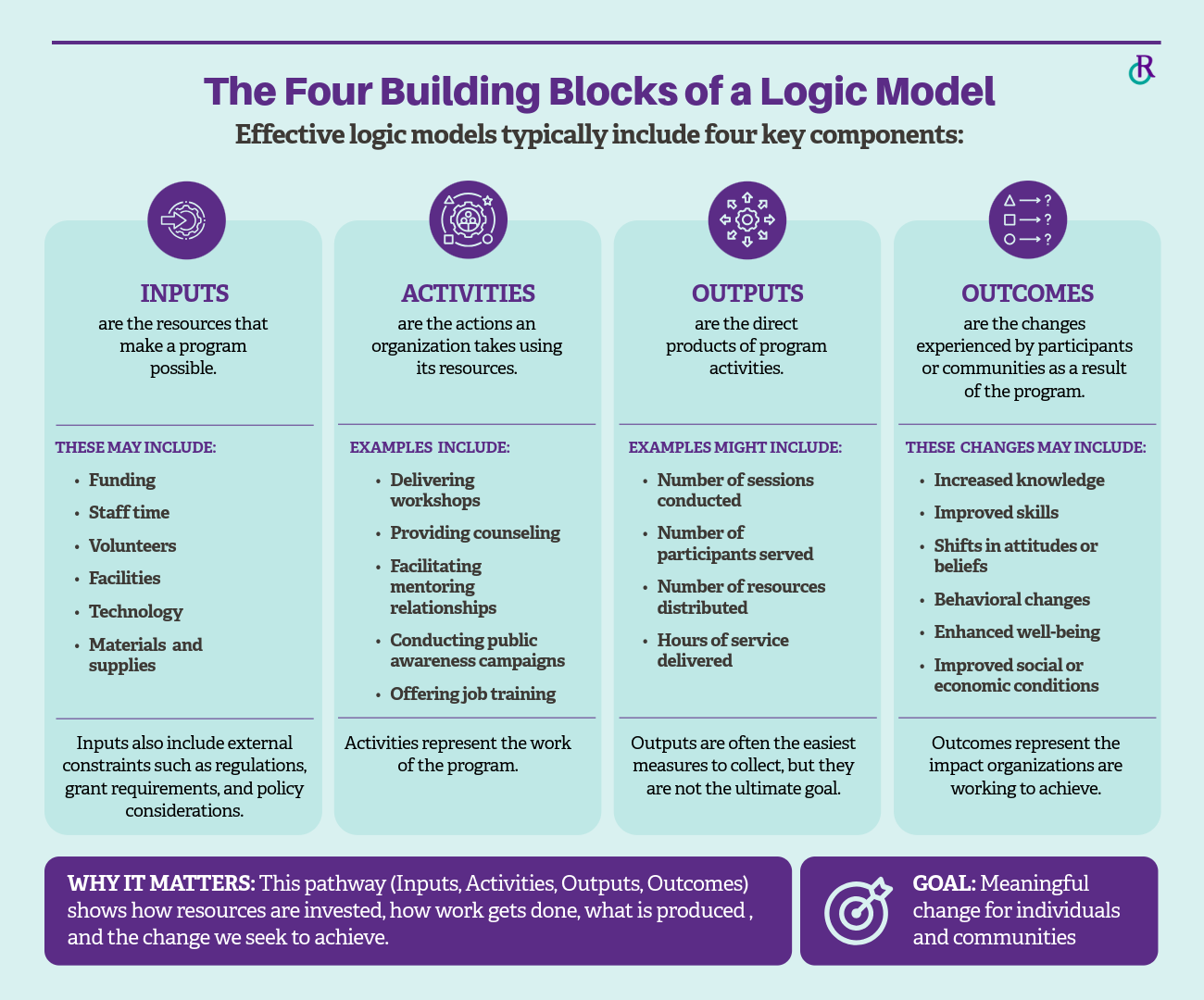
Effective logic models typically include four key components:
Inputs are the resources that make a program possible. These may include:
- Funding
- Staff time
- Volunteers
- Facilities
- Technology
- Materials and supplies
Inputs also include external constraints such as regulations, grant requirements, and policy considerations.
Activities are the actions an organization takes using its resources.
Examples include:
- Delivering workshops
- Providing counseling
- Facilitating mentoring relationships
- Conducting public awareness campaigns
- Offering job training
Activities represent the work of the program.
Outputs are the direct products of program activities.
Examples might include:
- Number of sessions conducted
- Number of participants served
- Number of resources distributed
- Hours of service delivered
Outputs are often the easiest measures to collect, but they are not the ultimate goal.
Outcomes are the changes experienced by participants or communities as a result of the program.
These changes may include:
- Increased knowledge
- Improved skills
- Shifts in attitudes or beliefs
- Behavioral changes
- Enhanced well-being
- Improved social or economic conditions
Outcomes represent the impact organizations are working to achieve.
Why Logic Models Matter
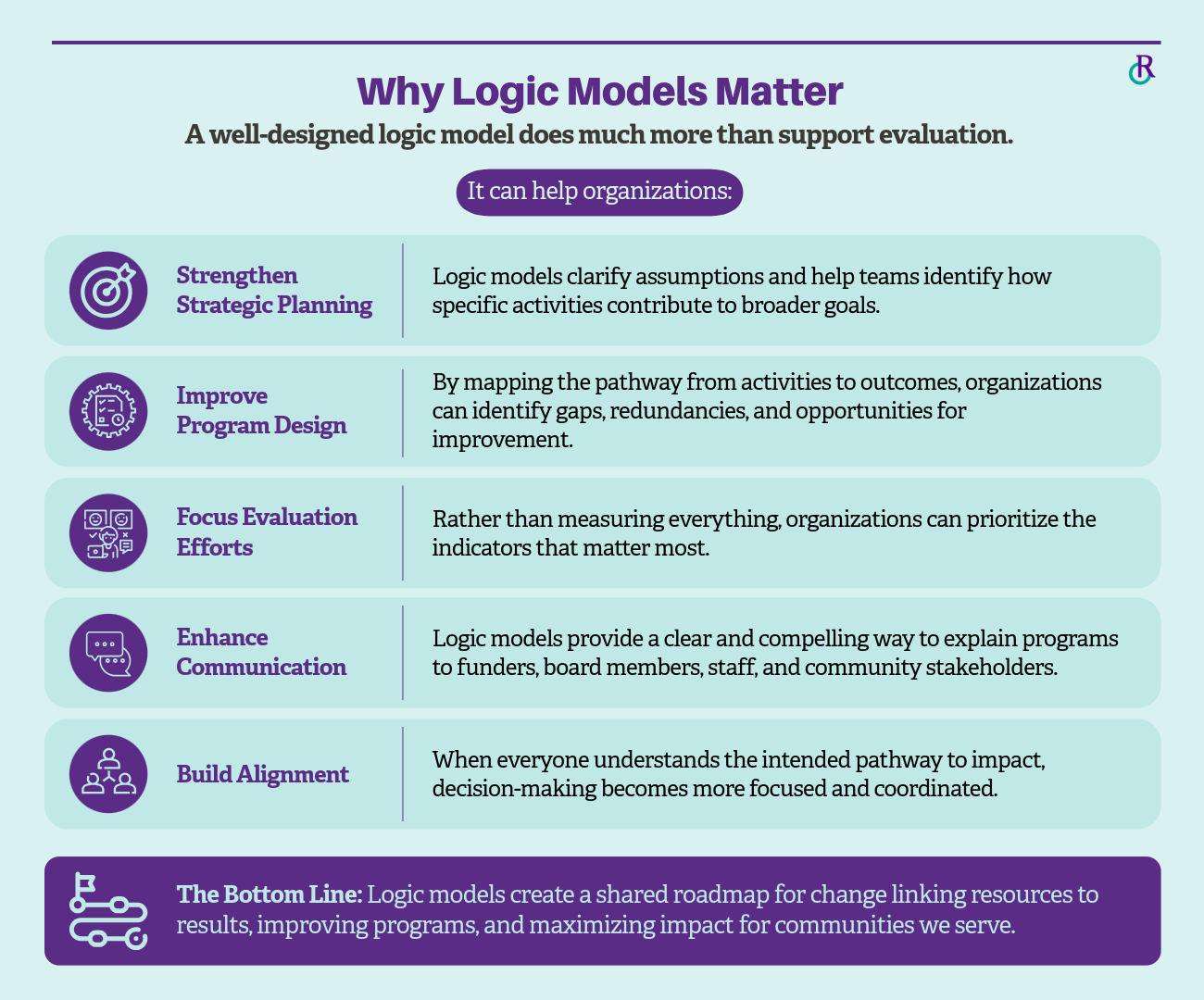
A well-designed logic model does much more than support evaluation. It can help organizations:
- Strengthen Strategic Planning
Logic models clarify assumptions and help teams identify how specific activities contribute to broader goals.
- Improve Program Design
By mapping the pathway from activities to outcomes, organizations can identify gaps, redundancies, and opportunities for improvement.
- Focus Evaluation Efforts
Rather than measuring everything, organizations can prioritize the indicators that matter most.
- Enhance Communication
Logic models provide a clear and compelling way to explain programs to funders, board members, staff, and community stakeholders.
- Build Alignment
When everyone understands the intended pathway to impact, decision-making becomes more focused and coordinated.
Ready to Build Your Own Logic Model?
Whether you’re designing a new initiative, strengthening an existing program, or preparing for an evaluation, a logic model can help you clarify how your activities connect to meaningful outcomes.
Download our free Logic Model Handout for a practical overview of the framework, key definitions, and examples you can use with your team.
📥 Download the Logic Model Handout: Introduction to Logic Models
A Simple Shift with Powerful Results
One of the most valuable questions a nonprofit can ask is: “How do we know our work is making a difference?”
Logic models help answer that question by making the pathway from investment to impact visible. Rather than stopping at what was done, organizations can begin demonstrating what changed—and why it matters. In an increasingly outcomes-focused environment, the ability to clearly articulate and measure impact is no longer optional. It is essential for learning, improvement, accountability, and long-term success. A logic model provides the foundation for that work.
At Rosov Consulting, we help organizations develop practical, meaningful logic models that strengthen strategy, evaluation, and impact. Whether you’re launching a new initiative, refining an existing program, or preparing for a major evaluation effort, a strong logic model can help ensure that your activities are connected to the outcomes you seek to achieve.